A Home Workout Corner That Does Not Take Over Your Living Room
Choose a few versatile pieces of exercise equipment around your space and habits.
ChoiceLark may earn a commission from qualifying purchases through affiliate links, where used. How our links work.
In this guide
The living room becomes a workout area when the coffee table moves aside. It becomes a living room again when the mat rolls up and the equipment returns to a shelf. In a shared or compact home, that transition is part of the routine, and it should influence what you buy.
A useful exercise corner does not need to resemble a gym. It needs appropriate space and equipment for activities you know how to perform, plus a storage arrangement that makes starting and finishing straightforward. This guide addresses shopping and organization, not an individualized exercise program or a promise of fitness results.
Start with the activity you will repeat
Write down what you already do or intend to learn with suitable instruction. A floor-based routine, resistance work, and indoor cycling create very different shopping lists. Equipment should support the activity rather than decide it for you.
The American Academy of Orthopaedic Surgeons advises considering familiarity, space, motivation, and trying equipment before purchase. That is a useful counterweight to buying a large machine because a short promotion makes it look effortless.
If a health condition or injury affects activity choices, seek appropriate professional guidance before choosing equipment. A product description cannot tell you what is suitable for your circumstances, and buying gear should not substitute for learning safe technique.
Measure the space while you are moving
The stored dimensions are only the beginning. Check the working space required by the exact equipment and activity, including overhead reach and clearance around furniture. Make sure the area remains clear of children, pets, and household traffic when used.
Consider the floor, lighting, ventilation, and nearby objects. A corner beside a swinging door is less practical than it appears when empty. If the routine involves a screen, find a stable position that does not require awkward viewing or trailing cables across your movement area.
Noise matters in shared buildings. Read the equipment instructions and consider the activities involved rather than assuming that a mat makes every movement quiet or protects every floor.
| Equipment direction | Why it can suit a small home | What to check |
|---|---|---|
| Exercise mat | Easy to roll or store flat | Grip, dimensions, care, and floor compatibility |
| Resistance bands | Compact storage for suitable routines | Material, condition, instructions, and approved anchors |
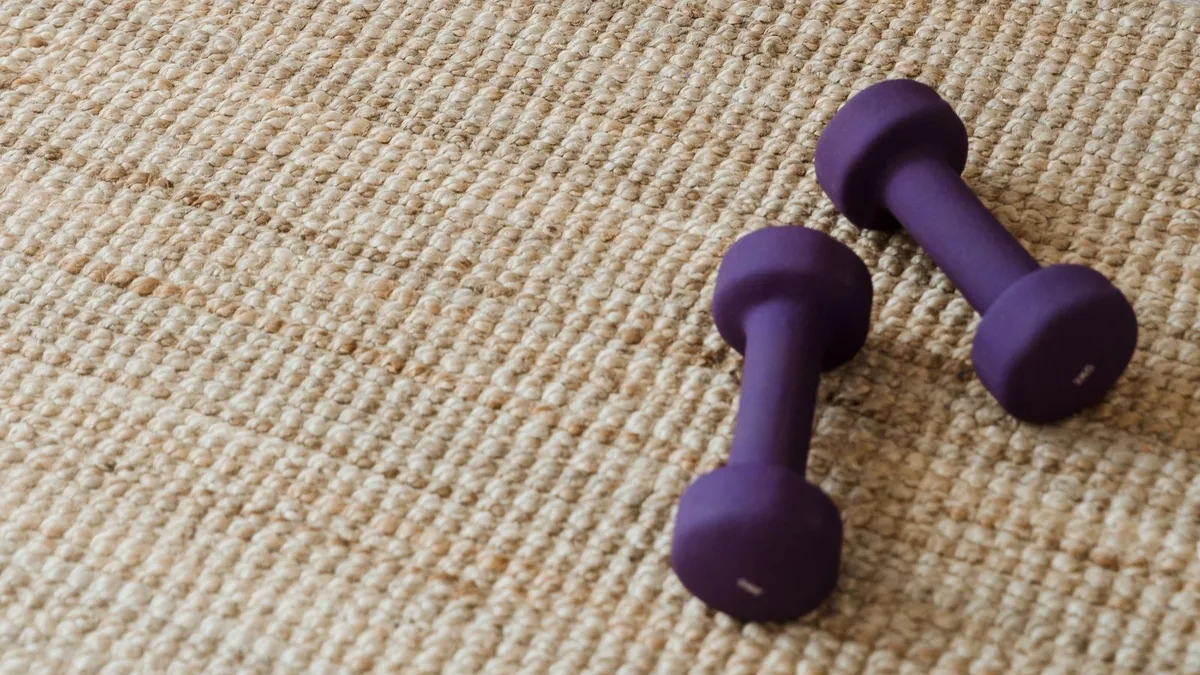
| A small selection of weights | Straightforward access for familiar exercises | Load suitability, handling, and stable storage |
| Adjustable equipment | Several settings in a smaller footprint | Mechanism, safe adjustment, and total working area |
Choose a mat by use, not color
A thicker mat may feel comfortable for one floor-based activity while being less suitable for another that benefits from a firmer surface. Compare the intended use, dimensions, material, and care instructions. Check that both you and the mat can move safely on the existing floor.
If you share the space, storage can settle the choice. A mat that is easy to clean, dry, and put away is more convenient than a large one that never has a proper home. Measure the rolled dimensions as well as the open footprint.
You may not need a new mat if you already own one suited to the routine. Keep the budget for an observed gap rather than replacing working equipment to match a coordinated set.
Compact bands still require proper use
Resistance bands are easy to store, but they are not interchangeable pieces of elastic. Check the manufacturer’s intended uses and resistance information. Color systems can vary across brands, so compare the actual specifications instead of assuming that a familiar color means a familiar load.
THERABAND’s published support guidance advises inspecting bands for wear and damage before use. Follow the instructions for your particular product, including any protective equipment, handling, and replacement guidance. Do not improvise an anchor from furniture or a door unless the equipment and installation method are explicitly designed for that use.
If the set includes more attachments than you understand, a simpler purchase may be easier to use responsibly. Learn the equipment before adding complexity.
Let storage limit the shopping list
Choose the shelf, cabinet, or stable floor position before the equipment arrives. Heavy items should have secure, appropriate storage rather than balancing in a decorative basket or on furniture that is not designed for the load.
Think through cleanup after a short session. If every item takes several minutes to retrieve and return, the setup may become a barrier. A few accessible pieces can be more practical than a broad collection stored in several rooms.
Avoid paying for connected features without understanding subscriptions, device compatibility, and what still works without an account. The useful question is whether a feature helps you repeat the activity, not whether the screen looks impressive.
For the rest of a multipurpose room, our small home-office upgrades guide applies the same principle: improve the task without surrendering the entire space.
Common equipment questions
Should beginners buy an entire set?
A set can include equipment that does not match your routine or current instruction. Start with the items you know you need, check their suitability, and add pieces when a clear use emerges.
Is adjustable equipment always the space-saving choice?
It can consolidate several settings, but compare the complete footprint, adjustment process, and storage requirements. A complicated mechanism that interrupts the routine may not suit everyone.
Can a living-room setup replace a gym?
That depends on your goals, instruction, preferences, and available space. The first question is whether the setup supports activities you will do regularly and appropriately, not whether it duplicates every machine elsewhere.
Sources and further reading
- AAOS OrthoInfo: selecting home exercise equipment
- Performance Health: THERABAND resistance-band guidance
Sources checked November 10, 2026. This article provides equipment-selection information, not medical advice or an exercise prescription.
TAKE THE NEXT STEP
Compare the options that fit your routine
Use the criteria in this guide to narrow your shortlist. Check the exact model, dimensions, current price, seller, and return policy before you buy.
Browse options on Amazon ↗This link opens a retailer search. Results and availability can change.